A Validated Prognostic Score for Time to Loss of Ambulation in Patients With Duchenne Muscular Dystrophy
Publication details
Summary
This study, published in Neurology, is about boys with Duchenne muscular dystrophy and a score that helps predict when they may stop being able to walk.
The researchers used data from 608 boys and sorted them into five risk groups. The score uses two simple tests, getting up from the floor and a 10-metre walk or run test. It worked well in a separate group of patients, too. The paper says this could help doctors talk with families about what to expect and could also help with planning clinical trials.
Keywords: Duchenne muscular dystrophy, walking, risk score, floor rise test, 10-metre walk/run, clinical trials, patient care.
Abstract
Background and Objectives
Development of a prognostic score for time to loss of ambulation (LoA) may help guide treatment of patients with Duchenne muscular dystrophy (DMD). Information from clinical data sources was used to create a prognostic score for LoA for use in practice.
Methods
Data used included 4 natural history databases and 3 clinical trial placebo arms. Inclusion criteria were as follows: (1) 6-minute walk distance ≥75 m; (2) a subsequent visit with an outcome assessment that identified LoA; (3) current corticosteroid use; and (4) available data on prognostic factors. Classification and regression tree models for time to LoA were used to classify patients into 5 risk groups (group 5 = highest risk), prioritizing the easily obtained rise from floor (RFF) and 10-m walk/run (10MWR) times as predictors. The prognostic score was validated in the Cooperative International Neuromuscular Research Group data.
Results
Data from 608 boys were analyzed (mean age 9.1 years). Kaplan-Meier curves for time to LoA for each risk group were well separated, describing meaningful differences in time to LoA. Median time to LoA for risk group 1 was not reached during a median of 2.0 years of follow-up. Median times to LoA for risk groups 2–5 were 4.4 (95% CI 4.0–inf), 3.0 (2.1–4.1), 2.0 (1.6–2.1), and 0.9 (0.8–1.6) years, respectively. These risk groups showed concordant times to LoA among 226 patients in the validation data and provided finer separation of patients across different levels of LoA risk than thresholds based on individual functional tests.
Discussion
Patients with DMD were classified into 5 risk groups for LoA using a simple, easy-to-use prognostic score based on RFF and 10MWR thresholds. The prognostic score replicated well in validation data and performed better than previously proposed classifications used in practice. Incorporating the prognostic score for time to LoA into a clinical visit may allow clinicians to counsel patients on trial eligibility, need for mobility devices, home adjustments, financial accommodations, and psychosocial needs. The prognostic score may also be used in trials to inform inclusion criteria and stratification. Study limitations included limited data for prediction of LoA risk beyond 4 years.
Related publications
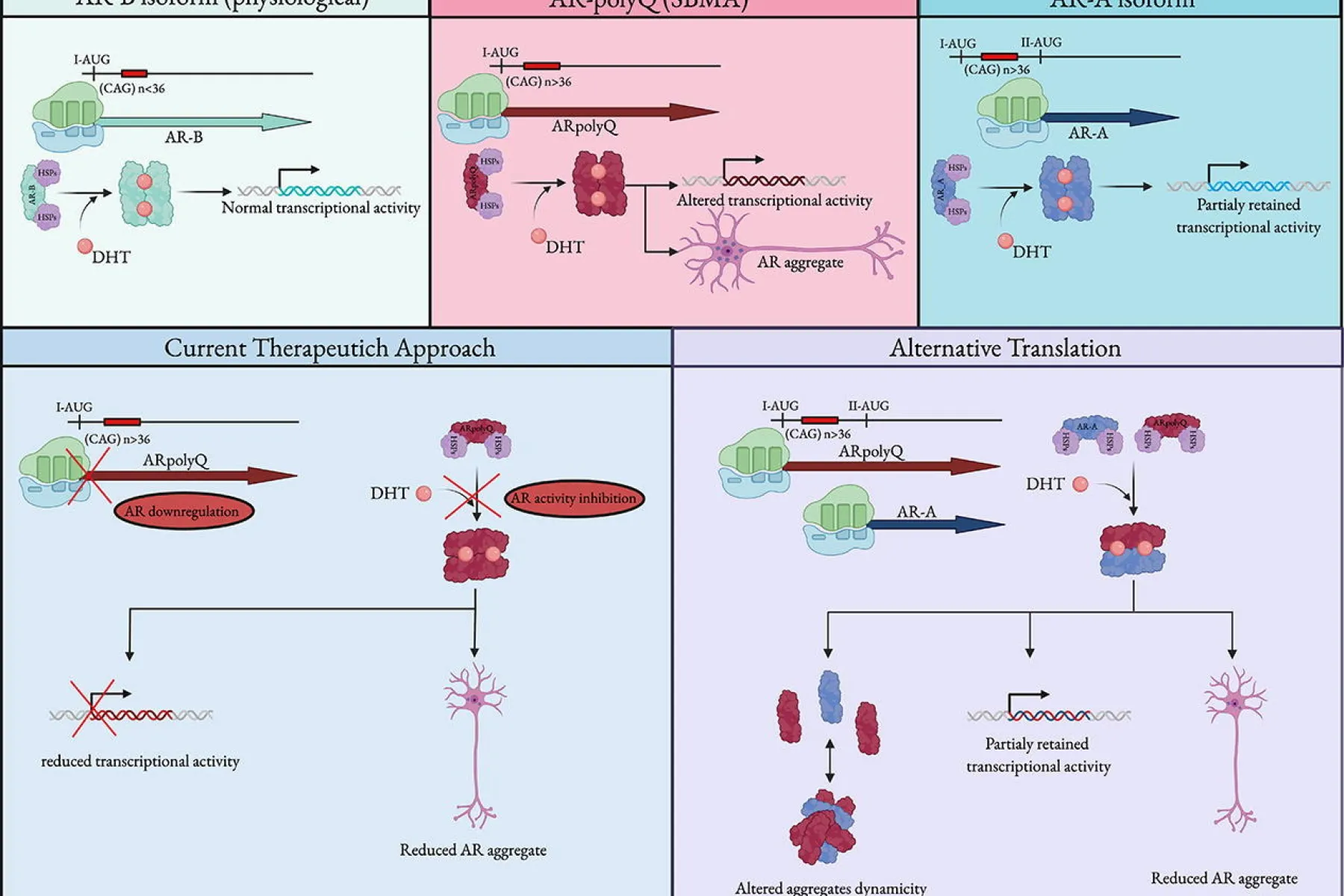
The alternative androgen receptor isoform A mitigates toxicity of polyglutamine-elongated mutant androgen receptor in spinal and bulbar muscular atrophy
Beyond innovation: why rare disease gene therapy needs a reset
Efficacy and safety of risdiplam in patients with type 1 spinal muscular atrophy: a 3-year open-label extension of the two-part, phase 2 FIREFISH trial
Genetic or pharmacological disruption of the MSH3 Y245/K246 IDL binding pocket slows CAG repeat expansion

Health economic evaluations of genomic newborn screening: Approaches by studies within the international consortium on newborn sequencing

Targeting toxic HTT1a could be the key to treating Huntington's disease

Spatial transcriptomics implicates the thalamus and cortex in autism and schizophrenia
The phenotypic spectrum and genetic determinants of severe spinal muscular atrophy in individuals with a single SMN2 copy: an international retrospective observational study
Personalized CRISPR therapies could soon reach thousands — here’s how