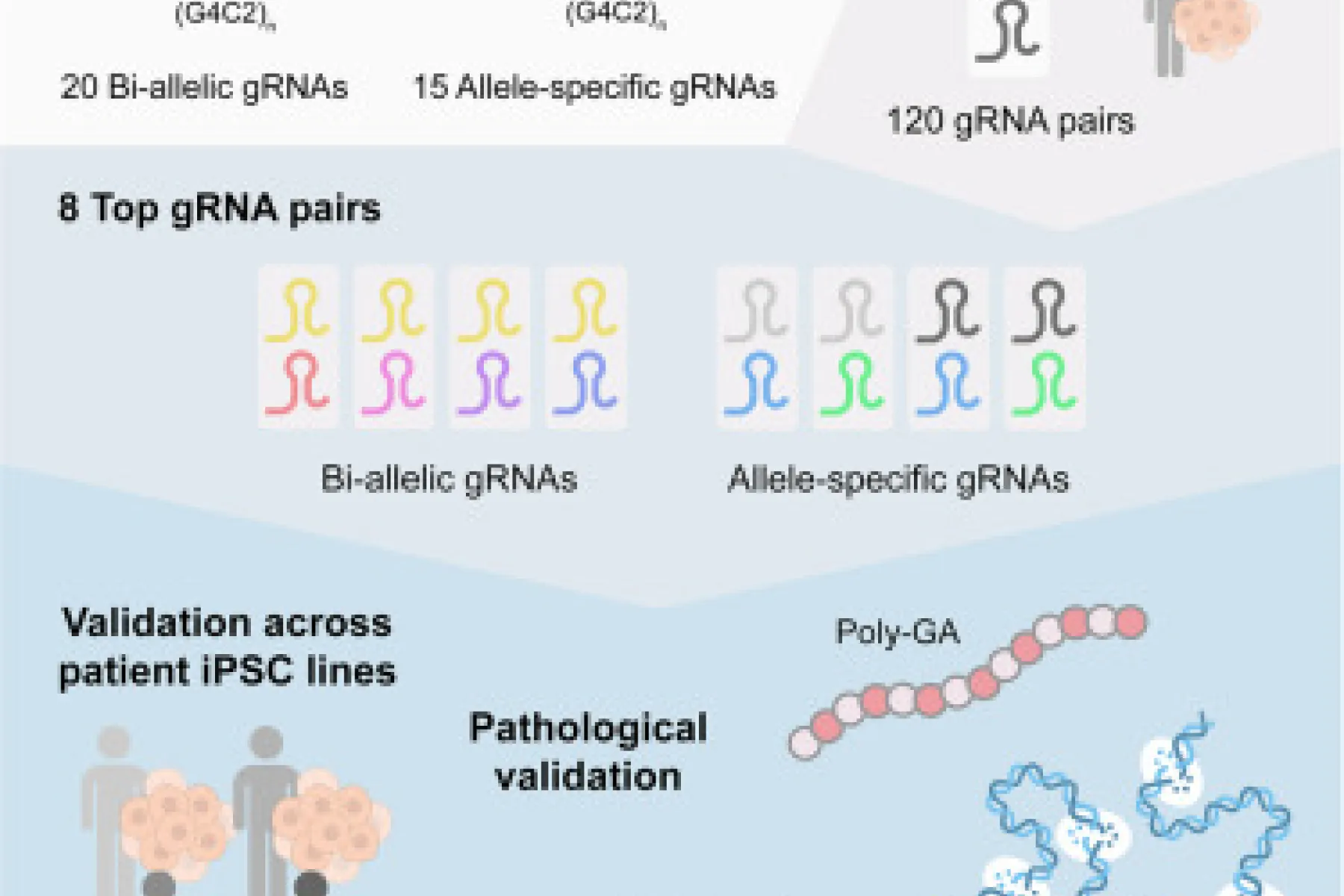
Genetic or pharmacological disruption of the MSH3 Y245/K246 IDL binding pocket slows CAG repeat expansion
Publication details
Summary
This study, published in the NAR Molecular Medicine, looks at a part of the MSH3 protein that helps it bind to DNA and start CAG repeat expansion in Huntington's disease. The authors changed this DNA-binding pocket in cells and found that repeat expansion was reduced. They also tested a small molecule that blocks this site and saw the same effect, including in brain cells made from people with Huntington's disease.
The study suggests that blocking this part of MSH3 could be a possible way to slow Huntington's disease in the future.
Keywords: MSH3, Huntington's disease, CAG repeat expansion, DNA repair, gene editing, small molecule, patient iPSCs, medium spiny neurones, repeat expansion disease, NAR Molecular Medicine.
Abstract
Recent genetic studies have shown somatic expansion of the CAG repeat is the key process driving Huntington's disease (HD) pathogenesis. Recognition of insertion-deletion loops (IDLs), lesions prone to form within the CAG repeat, by Mutsβ (MSH3/MSH2) is thought to be the primary event in the expansion process. This starts a cascade that leads to error-prone repair and incorporation of additional CAG units into the repeat. In vitro data shows MSH3 binds IDLs through a DNA-binding pocket formed by MSH3 residues Y245/K246. In this study, we investigated the significance of this DNA-binding motif in CAG repeat expansion using cell lines harbouring long, unstable HTT CAG repeats. Genetic disruption of the MSH3 Y245/K246 motif significantly reduced DNA interaction, exhibited MMR deficiency in a frameshift mutator assay, and abrogated repeat expansion in a U2OS cell line expressing mutant HTT exon 1. Pharmacological blockade of this site using a small molecule targeting the DNA-binding pocket similarly reduced DNA binding and repeat expansion in a U2OS cell line. Crucially, this molecule also slowed CAG repeat expansion in medium spiny neurones derived from HD patient-iPSCs. Targeting of the MSH3 IDL binding pocket may represent a possible therapeutic strategy.
Related publications
The alternative androgen receptor isoform A mitigates toxicity of polyglutamine-elongated mutant androgen receptor in spinal and bulbar muscular atrophy
Beyond innovation: why rare disease gene therapy needs a reset

Efficacy and safety of risdiplam in patients with type 1 spinal muscular atrophy: a 3-year open-label extension of the two-part, phase 2 FIREFISH trial
A Validated Prognostic Score for Time to Loss of Ambulation in Patients With Duchenne Muscular Dystrophy

Health economic evaluations of genomic newborn screening: Approaches by studies within the international consortium on newborn sequencing
Targeting toxic HTT1a could be the key to treating Huntington's disease

Spatial transcriptomics implicates the thalamus and cortex in autism and schizophrenia
The phenotypic spectrum and genetic determinants of severe spinal muscular atrophy in individuals with a single SMN2 copy: an international retrospective observational study

Personalized CRISPR therapies could soon reach thousands — here’s how